
 +91 7044535163



Google Ads vs Meta Ads: The 2026 Guide to Smarter Ad Spend for Your Business
18th May, 2026
14 min read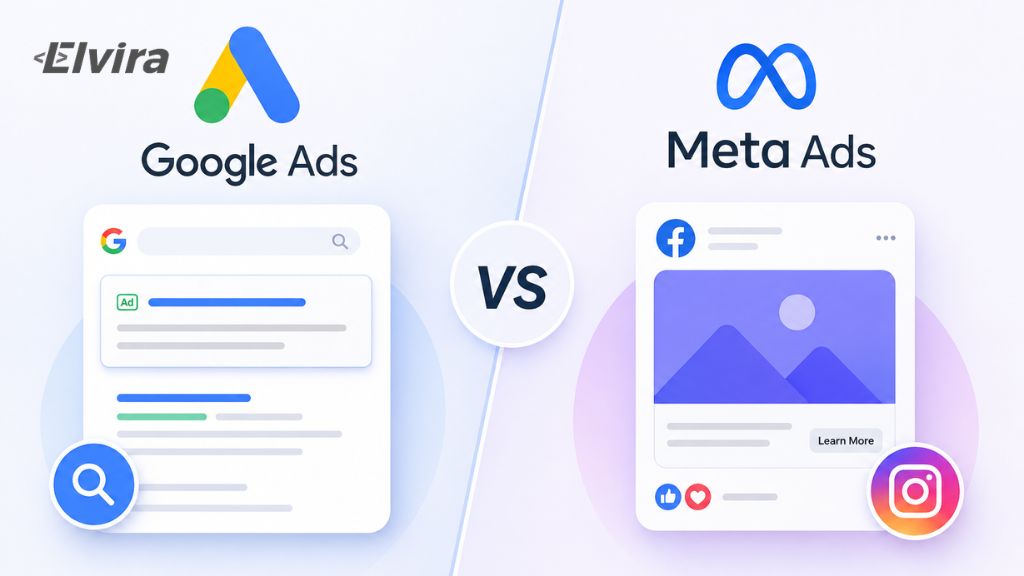
Here is a number worth stopping on: businesses waste an estimated 25 cents of every dollar they spend on digital advertising simply by choosing the wrong platform for their goals. If you are working with a modest monthly budget, that is not a statistic you can afford to ignore that is your money disappearing.
The Google Ads vs Meta Ads debate comes up in almost every marketing conversation in 2026. Both platforms are enormous, both are getting smarter with AI, and both can deliver strong results. But they were built to do fundamentally different things, and using the wrong one at the wrong stage of your funnel is one of the most common and costly mistakes in paid advertising.
This guide covers both platforms in depth how they work, where they perform, what the numbers actually look like in 2026, and how to make the decision that is right for your business.
What Are Google Ads?
Google Ads is a paid advertising platform that places your ads in front of people at the exact moment they are searching for a solution. When someone types a query into Google Search, your ad can appear at the top of the results positioned precisely when that person is ready to act.
The reach goes beyond search. Google’s advertising network spans YouTube, Gmail, Google Maps, and the Display Network a collection of millions of websites and apps across the open web. A single Google Ads account can put your message in front of people at multiple points in their day.
How Google Ads Work
Keyword-based targeting is at the core of Search campaigns. You bid on keywords relevant to your business; when someone searches a matching query, your ad enters an auction. The winner isn’t just the highest bidder Google factors in your Quality Score, which measures ad relevance, expected click-through rate, and landing page experience. A well-optimised account with a strong Quality Score can win placements at a lower cost than a competitor spending more carelessly.
Smart Bidding now drives 78% of all Google Ads spend in 2026. Rather than setting bids manually, you give Google a goal a target cost per acquisition, or a target return on ad spend and machine learning adjusts bids in real time based on dozens of contextual signals. Advertisers using AI bidding report 22% lower cost per conversion on average compared to manual strategies.
Performance Max is Google’s unified campaign type that serves ads across all Google inventory simultaneously from a single asset-based campaign. It is powerful when fed with strong creative assets and clean conversion data, but requires a minimum of 30 to 50 monthly conversions before the algorithm optimises reliably.
What Are Meta Ads?
Meta Ads is a paid social advertising platform that places your content in front of people while they are browsing Facebook, Instagram, Messenger, and the Meta Audience Network. The key distinction from Google is intent: users on Meta are not searching for anything. They are scrolling, discovering, and being interrupted by content that catches their attention.
This changes everything about how the platform works and what it takes to perform well on it. Where Google matches your ad to a query, Meta matches your ad to a person based on who they are, what they are interested in, and how they have behaved online.
How Meta Ads Work
Objective-based campaigns are the foundation. You define what you want awareness, traffic, leads, or conversions and Meta’s algorithm finds the people most likely to complete that action. The system learns from every interaction and continuously refines who it shows your ads to.
Advantage+ campaigns are now Meta’s default recommended approach following the removal of detailed targeting exclusions in early 2025. Rather than building precise audience segments manually, advertisers provide strong creative assets and let Meta’s AI determine the optimal audience and placements. For e-commerce brands in particular, Advantage+ Shopping campaigns have shown consistently strong results.
Creative is everything on Meta. The ad itself the image, video, or carousel carries most of the conversion weight. A strong hook in the first two seconds of a video can make the difference between a campaign that scales and one that flatlines. Average CTR on Meta rose to 2% in 2026 (up from 0.9% in 2024), with lead generation campaigns achieving the highest CTR at 2.59%.
Demand Harvesting vs. Demand Generation The Most Important Concept in Paid Advertising
Every paid advertising platform falls into one of two camps, and understanding which camp you are in changes your creative strategy, your budget expectations, and your conversion timeline.
Google Ads harvests existing demand. When someone searches for a service or product, the intent is already there. You are showing up at the moment a decision is forming. For established categories legal services, home repairs, accounting software there is a large, pre-existing pool of people actively looking. Your job is simply to intercept them.
Meta Ads generates new demand. Nobody opens Instagram hoping to see an ad. Meta works by interrupting a scroll with something compelling enough to create desire that didn’t exist five seconds earlier. This is enormously powerful for products that are visual, novel, or solve problems people haven’t consciously articulated yet but it requires more creative effort, more touchpoints, and a longer journey to conversion.
The strongest paid advertising strategies in 2026 use both platforms together: Meta to build awareness and warm up cold audiences, Google to capture the intent when those same people are ready to search and buy.
What Both Platforms Have in Common in 2026
Despite their differences, Google and Meta are converging in some important ways that every advertiser should understand.
AI automation is now the default on both. Performance Max on Google and Advantage+ on Meta have both moved advertisers away from manual control and toward machine-learning-driven optimisation. The implication: clean conversion data, strong creative assets, and reliable tracking now matter more than technical bidding expertise. If your data is poor, the algorithm is flying blind regardless of how much you spend.
Privacy changes have reshaped targeting on both. Cookie deprecation has affected Google’s Display and Remarketing capabilities, while EU data restrictions have limited Meta’s personalisation in certain regions. Both platforms have responded Google with Enhanced Conversions, Meta with the Conversions API but first-party data is now an asset that makes a measurable difference to performance.
Attribution is a shared challenge. Both platforms over-report conversions in their own dashboards. A person who sees a Meta ad and later converts through a Google search may be counted as a conversion on both platforms simultaneously. This is not fraud it is a difference in attribution windows and models but it means you should never compare Google and Meta conversion numbers directly against each other.
Cost and Performance Benchmarks for 2026
The numbers tell a clear story about where each platform sits in terms of cost and performance but the headline figures require context.
$2.96 Google Ads avg. CPC (Search) up 12% YoY | $0.70 Meta Ads avg. CPC (traffic campaigns) | 7.52% Google Search avg. conversion rate | 2.59% Meta lead gen campaign CTR (highest objective) |
Google’s average CPC for Search rose 12% year over year to $2.96 in Q1 2026, with CPC increases seen across 87% of industries. Legal services remain the most expensive vertical at $6.75 per click, while e-commerce maintains a more accessible $1.16. The average conversion rate across Google Search reached 7.52% meaning roughly 1 in 13 clicks becomes a lead or sale.
Meta’s traffic campaigns average just $0.70 per click in 2026, making it significantly cheaper on a cost-per-click basis. But cheaper clicks don’t automatically mean better returns. Meta’s lower intent means conversion rates are typically lower too around 0.9% to 2% depending on the objective and creative. The real comparison metric isn’t CPC, it’s cost per acquisition.
On cost per lead, Meta’s average CPL reached $27.66 in 2026, while Google’s average cost per conversion sits at $53.89. Those figures look straightforward, but they mask important quality differences leads from Google Search tend to be further down the buying journey, while Meta leads often require more nurturing before they convert to customers.
Google Ads vs Meta Ads Head to Head
| Google Ads | Meta Ads | |
| User intent | Actively searching for a solution | Passive — scrolling, not shopping |
| Demand type | Captures existing demand | Creates and generates new demand |
| Avg. CPC (2026) | $2.96 (Search avg.) | $0.70 (traffic campaigns) |
| Avg. conversion rate | 7.52% (Search) | 0.9%–2.59% (varies by objective) |
| Avg. cost per lead | $53.89 | $27.66 (lead gen campaigns) |
| Creative importance | Ad copy relevance drives Quality Score | Visual creative is the primary variable |
| Funnel stage | Bottom and mid-funnel | Top and mid-funnel |
| Best for B2B | High-intent service searches | Audience targeting + brand awareness |
| Best for e-commerce | Google Shopping — 6.2% CVR | Meta catalog ads — broader discovery |
| Attribution model | Click-based, CRM-connectable | Modelled view + click with AI estimation |
The Budget Allocation Reality Where Should Your Money Actually Go?
There is no universal formula, but there are frameworks that reflect how different business types perform on each platform. Here is a practical starting point.
| Business Type | Google % | Meta % | Rationale |
| Service Business | 60–70% | 30–40% | Use Google to capture immediate high-intent leads; Meta to stay visible with warm audiences |
| E-Commerce Brand | 30–40% | 50–60% | Meta drives discovery; Google Shopping captures buyers who already know what they want |
| SaaS / B2B | 55–65% | 35–45% | Google wins bottom-funnel; Meta feeds Google remarketing lists with lower-CPC awareness |
| Local Business | 60%+ | 30–40% | Google Search + Maps captures nearby intent; Meta builds local brand recall |
| New Brand Launch | 30% | 70% | Awareness and audience-building first; scale Google once search intent develops |
The brands achieving the highest ROAS in 2026 are not picking one platform over the other. They are running coordinated campaigns using each for what it does best and measuring on a unified cost per acquisition, not platform-native conversion numbers
When to Use Google Ads and When to Choose Meta
Google Ads Is the Right Choice When…
Your product or service has clear, searchable demand people are actively typing queries that describe what you offer. Service businesses like legal, medical, financial, and home improvement see some of the highest conversion rates on Google Search precisely because people search when they have an urgent need. Google Shopping works exceptionally well when buyers know the product they want and are comparing prices. Performance Max makes sense once you have sufficient conversion data feeding the algorithm.
Meta Ads Is the Right Choice When…
You are selling a product or experience that benefits from visual demonstration fashion, food, interiors, fitness, beauty, or anything where showing beats telling. Meta is also the stronger choice when your audience is defined by lifestyle, interests, or behaviour rather than a specific search query. For retargeting warm audiences who have visited your site without converting, Meta’s lower CPM often delivers better cost-efficiency than Google Display.
What Changed in 2026 That Is Reshaping Paid Ads Results
2026 is not a minor update year for paid advertising. Several platform-level changes have significantly altered how campaigns perform and advertisers running strategies unchanged from 2024 are likely overpaying for results.
Meta removed detailed targeting exclusions in March 2025. Advertisers can no longer exclude specific audiences from seeing their ads, which fundamentally changed how audience management works. The shift forces reliance on broad targeting and creative-led optimisation rather than surgical audience sculpting. Accounts that haven’t adapted are spending on poor-fit impressions.
Google’s AI Overviews reduced organic search click volume by 8–12%. When Google answers a query directly in the search results page, fewer people click through to websites. This is pushing more traffic through paid channels and contributing to the CPC inflation seen across industries in 2026.
Enhanced Conversions for Leads on Google expanded attribution windows, which can inflate apparent conversion rates in your dashboard. This is causing some advertisers to overbid believing their campaigns are performing better than they actually are. Checking CRM pipeline data against Google’s conversion numbers is essential.
Meta’s ad CPL rose 20.94% year over year. Rising competition and the removal of targeting exclusions have pushed costs higher. Ad sets with 3 to 10 creative variations now perform significantly better than single-creative campaigns creative refresh frequency is a performance lever, not just an aesthetic one.
Why Google Ads and Meta Ads Conversion Numbers Never Match
This confuses almost every advertiser who runs both platforms. You run a campaign on Meta, it reports 50 conversions. On Google Analytics, it shows 35 and on your CRM, it shows 28. All three are measuring the same period. Which number is right?
None of them and all of them, depending on what you’re asking. Each tool uses a different attribution model. Meta uses a 7-day click, 1-day view window by default, meaning it credits itself for a conversion if someone saw your ad and then converted within a week even if they never clicked. Google uses last-click attribution by default in many reporting views, which credits the final touchpoint before conversion. Your CRM only records contacts who were properly tagged and submitted a form.
The fix is not to reconcile these numbers to a single figure. It’s to establish consistent measurement rules and use a platform-agnostic tool Google Analytics 4 with data-driven attribution, or a dedicated attribution platform as your single source of truth. Compare platforms on cost per acquisition using that neutral source, not on their own reported conversion counts.
Always measure performance with a third-party analytics tool. Both Google and Meta inflate their own conversion numbers not maliciously, but because their attribution models are designed to show their platform in the best light.
What Advertisers Are Complaining About Most in 2026
On Google Ads
The most consistent complaints in 2026 centre on loss of control. Performance Max gives limited visibility into where budget is actually being spent advertisers can see total impressions and conversions, but not which specific placements or search terms are driving results. This is a meaningful change from the granular keyword-level control that defined Google Ads for a decade. Coupled with CPC inflation across 87% of industries, advertisers with smaller budgets are finding it harder to compete in crowded verticals without expert account management.
On Meta Ads
The removal of detailed targeting exclusions has been the biggest operational pain point. Advertisers who built their strategy around precise audience exclusions keeping existing customers out of acquisition campaigns, separating cold and warm audiences have had to rebuild their approach entirely. Rising CPL (up 20.94% year over year) and inconsistent results from broad targeting have eroded confidence for accounts that relied on audience sculpting rather than creative strength.
The other persistent frustration is attribution. Meta’s modelled, view-through attribution regularly over-counts conversions in ways that are hard to audit leading to budget decisions made on optimistic data.
Which Platform Should You Choose in 2026?
If you came here hoping for a definitive winner, here is the honest answer: there isn’t one. There is only the right platform for your specific goal, funnel stage, and business type.
Choose Google Ads when your customers are actively searching for what you offer, when conversion speed matters, or when you need measurable lead generation with clear cost-per-lead targets. The intent is already there your job is to be visible and relevant when it surfaces.
Choose Meta Ads when you need to build brand awareness, when your product benefits from visual storytelling, when you’re targeting specific demographic groups, or when you need to keep your brand visible to warm audiences at a lower cost than Google Display.
Run both when you want to build a full-funnel system that catches customers at every stage. Meta introduces your brand and warms your audience. Google captures the intent when those same people go searching. The compound effect of running both platforms together each doing what it does best consistently outperforms going all-in on either one alone.
Need Help Getting Your Paid Ad Strategy Right?
Understanding the theory is one thing. Executing it well setting up tracking correctly, building campaigns that feed the algorithm good data, writing creative that performs, and interpreting results without being misled by platform-native dashboards is where the real work is.
Elvira Infotech is an ISO 9001 certified digital marketing and development company. We help businesses build and manage paid advertising strategies across Google and Meta, grounded in clean data, honest attribution, and a clear understanding of what each platform is best suited to do. From initial campaign setup and audience strategy to ongoing optimisation and cross-platform reporting, we manage the full picture.
If your current paid campaigns aren’t delivering the returns you expect, or if you’re starting from scratch and want to avoid the most expensive early mistakes, we’re here to help.
Reach out to the Elvira Infotech team. We’ll review your current setup, identify where your budget is working and where it isn’t, and build a paid media strategy that makes sense for your specific business goals.
Our Recent Blogs

10th Sep, 2026
16 min readWhat Is API Integration? And Why Every Business Website Needs It in 2026
Every time a customer pays for an order on your website, gets a confirmation email, sees...
18th Aug, 2026
13 min readHeadless CMS vs WordPress: What’s Really Better for Your Website in 2026?
If you’ve spent any time researching website platforms lately, you’ve probably run into the term “headless...
13th Jul, 2026
16 min readProgressive Web Apps vs Native Apps: The Complete 2026 Business Decision Guide
Every business thinking about building a digital product faces the same fork in the road: do...