
 +91 7044535163



Web Design Services: What They Include and Why They Matter for Your Business
6th May, 2026
13 min read
Your website is working right now or it isn’t. It’s either turning visitors into customers, building trust, and showing up on search engines, or it’s sitting there costing you money without doing much in return. The difference between those two outcomes often comes down to one thing: the quality of the web design service behind it.
In 2026, a website is far more than a collection of pages with your logo on them. It’s a 24/7 sales tool, a first impression that takes 0.05 seconds to form, and a platform that either supports your entire digital strategy or quietly undermines it. Getting the design right across every layer, from structure to speed is one of the most important investments a business can make online.
This guide covers everything you need to understand about professional web design services: what they include, what each element actually does for your business, and how to use modern technology to build something that performs well into the future.
What Is a Web Design Service?
Web design services are the professional processes involved in planning, creating, and launching a website. But that definition barely scratches the surface of what a serious web design engagement actually covers.
A web design service begins well before anyone opens a design tool. It starts with understanding your business, your audience, how people move through your site, and what action you want them to take. From there, it moves through visual design, development, performance optimisation, and SEO integration before the site ever goes live.
The critical thing to understand is that design and development are deeply intertwined. A site that looks beautiful but loads slowly will drive visitors away. A site that’s technically sound but confusing to navigate won’t convert. Professional web design services treat all of these dimensions together not as separate concerns.
94% of users form their first impression of a business based on its website design. That impression happens in 50 milliseconds before anyone has read a single word.
0.05s for users to form a first impression | 94% of first impressions are design-based | 88% won’t return after a poor experience | $100 ROI for every $1 invested in UX |
What Are Web Design Services Available?
Professional web design services cover a wide spectrum, and what’s included varies significantly depending on the provider and the project. Here’s a clear picture of what a comprehensive web design service typically covers.
Information Architecture and UX Planning
Before a single colour is chosen or a pixel placed, good web design starts with structure. Information architecture (IA) is the process of deciding how content gets organised, labelled, and connected so that users can find what they need without thinking too hard.
This stage includes creating sitemaps visual maps of every page on the site and how they connect and wireframes, which are rough structural blueprints of individual pages. Wireframes look like simple sketches, but they’re doing important work: they establish where navigation sits, where the main content goes, where calls to action appear, and how users move from one step to the next.
UX planning at this stage also involves reviewing the customer journey. Where are users coming from? What do they need to know before they’ll take an action? What might make them leave? Answering these questions before design work begins prevents a great deal of expensive rework later.
61.5% of website redesign projects are undertaken specifically to fix user experience issues problems that could have been solved at the planning stage.
Visual Design and Design Systems
Visual design is where most people think web design begins and it’s where the personality of a site comes to life. Typography, colour, spacing, imagery, iconography, and layout all work together to communicate what a brand stands for and guide users towards the actions you want them to take.
In 2026, professional web design goes beyond producing a set of static page designs. It involves building a design system a reusable library of components (buttons, forms, cards, navigation elements) that maintains consistency across the entire site and scales cleanly as the site grows. A design system makes future updates faster and cheaper, because every element follows the same rules.
Visual hierarchy matters enormously here. The way size, weight, contrast, and position are used tells users where to look first, what matters most, and what to do next all without them consciously registering it.
User Experience (UX)
UX isn’t a feature you add to a website it’s the quality of the entire experience of using it. A strong UX means users can find what they’re looking for quickly, understand what actions are available to them, and complete tasks without friction or confusion.
The business case for investing in UX is compelling. Every $1 invested in UX design yields an average return of $100 a 9,900% ROI according to Forrester research. A seamless UX can boost conversion rates by up to 400%. A 5% improvement in user retention driven by better UX can grow profits by 25% to 95%.
Poor UX, on the other hand, costs in ways that are easy to miss. Visitors leave without converting. 91% of dissatisfied users exit without leaving feedback so you often don’t even know why. The experience of using your site is shaping your brand reputation whether you’re paying attention to it or not.
User Interface (UI) Design
If UX is about how a website works, UI is about how it looks and behaves at the component level the buttons, form fields, menus, icons, and interactive elements that users actually touch and click.
Good UI design is precise, consistent, and purposeful. Every element has a reason to be where it is. Colours carry meaning (green for confirmation, red for errors). Interactive states hover, active, disabled are clearly distinct so users always know what they can do. Typography is chosen not just for aesthetics but for legibility across devices and screen sizes.
Well-executed UI design can increase a website’s conversion rate by up to 200%. That’s not a marginal improvement it’s the difference between a site that generates enquiries and one that doesn’t, from the exact same traffic.
Responsiveness and Mobile-First Design
Between 58% and 60% of global web traffic now comes from mobile devices. On e-commerce specifically, mobile drives 78% of retail traffic. A website that doesn’t work properly on a phone isn’t a minor inconvenience it’s a significant revenue problem.
Responsive design means the site automatically adapts its layout to fit the screen it’s being viewed on whether that’s a desktop monitor, a tablet, a phone, or anything in between. Content reflows, images resize, navigation transforms all without requiring a separate mobile version of the site.
In 2026, responsive design has become the standard expectation. 90% of websites worldwide have implemented it. More importantly, 62% of top-ranking websites on Google are optimised for mobile making responsiveness a direct factor in search visibility, not just user experience.
Speed Optimisation
Website speed is not a technical nicety it’s a business-critical factor that affects everything from search rankings to revenue. A 1-second delay in page load time leads to a 7% drop in conversions. Retailers lose an estimated $2.6 billion annually due to slow websites. Sites loading in 1 second convert three times better than those taking 5 seconds.
Speed optimisation as part of a web design service includes image compression, efficient code structure, caching strategies, content delivery network (CDN) setup, and Core Web Vitals compliance. Only 47% of sites currently meet Google’s Core Web Vitals thresholds meaning the majority of websites have a measurable performance problem that’s affecting both their rankings and their conversions.
SEO Integration
Search engine optimisation and web design are inseparable in 2026. Google’s ranking signals now include design-related performance metrics page speed, Core Web Vitals, mobile usability, and accessibility. A site that performs poorly on these signals will rank lower regardless of how good its content is.
SEO integration in a web design service covers clean, crawlable code structure, proper heading hierarchy, semantic HTML, meta tag setup, schema markup, XML sitemap generation, and internal linking architecture. These elements don’t guarantee rankings, but they remove the technical barriers that prevent search engines from properly understanding and indexing your content.
It’s also worth noting that 62% of top-ranking Google results are mobile-optimised which confirms that responsive design and SEO are two sides of the same coin.
200% conversion uplift from strong UI design | 400% conversion uplift from strong UX design | 60% of web traffic is mobile in 2026 | 47% of sites meet Core Web Vitals thresholds |
Common Web Design Services — What to Expect
Whether you’re building a new site from scratch or redesigning an existing one, most professional web design engagements will cover some combination of the following service areas.
| 01 | Custom Website DesignA bespoke website built to your brand, audience, and objectives not a template. Includes discovery, wireframing, visual design, development, and launch. |
| 02 | E-Commerce Design and DevelopmentOnline stores require additional layers: product page optimisation, basket and checkout UX, payment integration, and performance under high traffic loads. |
| 03 | Landing Page DesignConversion-focused single pages built for specific campaigns, product launches, or lead generation designed to direct attention towards one action. |
| 04 | Website RedesignUpdating an existing site to improve performance, modernise the visual design, fix UX issues, or align with a rebrand. 61.5% of redesigns are driven by UX problems. |
| 05 | CMS-Based DevelopmentBuilding on content management platforms so your team can update pages, add blog posts, and manage media without technical knowledge. |
| 06 | Design AuditsA structured review of an existing website identifying UX weaknesses, accessibility issues, performance bottlenecks, and conversion barriers with a prioritised roadmap to fix them. |
| 07 | Ongoing Maintenance and SupportPost-launch support covering security updates, performance monitoring, content changes, and technical fixes to keep the site running well over time. |
How Web Design Directly Affects Business Success
There’s a persistent assumption that web design is mostly about aesthetics that it makes the site look nice, which is good for the brand but hard to measure. That assumption is wrong, and the data makes it clear.
75% of people judge a company’s credibility based on its website design. 48% specifically cite design as the top factor in evaluating a business’s trustworthiness. 50% of consumers believe website design is directly linked to a business’s overall brand. These perceptions happen before a single word is read.
Beyond trust, the commercial impact is direct. Design-led companies have outperformed the S&P 500 by 228% over a 10-year period according to the McKinsey Design Index. Companies that prioritise UX see 1.5x faster revenue growth than their competitors. Better navigation alone can reduce bounce rates by 10–15% and increase task success rates by up to 40%.
The negative case is equally stark. 88% of users won’t return after a poor website experience. 89% of shoppers will switch to a competitor after a bad interaction. 52% of users won’t revisit a website because of aesthetics alone. A website that doesn’t work well isn’t neutral it’s actively sending customers to your competitors.
Design-driven companies outperformed the broader market by 228% over 10 years. This isn’t a coincidence it reflects the compounding business impact of every touchpoint working well.
What Do Basic Web Design Services Cover?
Not every project needs a full custom engagement. For smaller businesses just establishing their online presence, a basic web design service typically includes a clean, professionally designed website of 5 to 10 pages home, about, services, contact, and perhaps a blog.
A basic service will cover a responsive layout that works on mobile, a standard CMS setup so you can update content yourself, basic on-page SEO setup, a contact form, and integration with your existing domain and email. It’s a solid starting point that gets a professional presence online without the complexity or cost of a full custom build.
The difference between basic and advanced web design services isn’t just about how the site looks it’s about how much strategic thinking, custom functionality, and performance engineering goes into it. Businesses with more complex needs, higher traffic expectations, or tighter conversion requirements will outgrow a basic service quickly.
8 Technologies Powering the Future of Web Development
Web design doesn’t exist in isolation it sits on top of a technology stack that shapes what’s possible. These eight technologies are defining how modern websites are built and how businesses are gaining a competitive edge.
| 01 | Progressive Web Apps (PWAs)PWAs deliver app-like experiences through a browser offline access, push notifications, home screen installation without requiring users to visit an app store. They combine the reach of a website with the experience quality of a native app. |
| 02 | Headless CMS ArchitectureSeparating the content layer from the presentation layer allows content to be delivered to any frontend websites, apps, digital displays from a single source of truth. Faster, more flexible, and easier to scale than traditional CMS setups. |
| 03 | AI-Assisted Design and PersonalisationAI tools are accelerating design production and enabling personalised web experiences showing different content, layouts, or CTAs based on user behaviour. Businesses using AI-driven personalisation are seeing customer engagement rise by around 30%. |
| 04 | React and Next.js for PerformanceModern JavaScript frameworks like React and Next.js enable server-side rendering, static site generation, and partial prerendering delivering significantly faster initial load times and better SEO performance than traditional client-side rendering alone. |
| 05 | Core Web Vitals ComplianceGoogle’s Core Web Vitals measuring loading performance, interactivity, and visual stability are now ranking signals. Building to these standards from the start rather than retrofitting them later is becoming a baseline requirement for competitive websites. |
| 06 | Accessibility-First DevelopmentWCAG (Web Content Accessibility Guidelines) compliance is no longer optional it’s a legal consideration in many contexts and a trust signal to users. Accessible design typically improves usability for everyone, not just users with specific needs. |
| 07 | Motion Design and Micro-InteractionsSubtle animations a button that responds to a hover, a page that transitions smoothly, a form field that confirms input reduce cognitive load and make interfaces feel natural. When done with restraint, motion design significantly improves perceived quality without harming performance. |
| 08 | Voice and Conversational UIAs voice search and AI assistants become more embedded in user behaviour, websites are beginning to accommodate natural language queries and conversational interaction patterns. Implementing voice UI gives businesses a competitive edge as user expectations continue to evolve. |
Looking for a Web Design Partner That Delivers All of This?
Understanding what good web design covers is one thing finding a team that can deliver all of it, consistently and to a measurable standard, is another.
Elvira Infotech is an ISO 9001 certified company with expertise across the full spectrum of web design and development services. From information architecture and UX strategy through to visual design, front-end development, performance optimisation, and SEO integration, our team builds websites that are designed to perform not just to look good.
We work across custom website builds, e-commerce development, web application development, and ongoing maintenance, using modern technologies including React, Next.js, headless CMS platforms, and AI-assisted design tools. Every project follows our documented quality management process, which is what the ISO 9001 certification reflects.
Get in touch with Elvira Infotech. Tell us what you’re building or what’s not working with what you have, and we’ll give you a straight, honest assessment of what it will take to fix it.
Our Recent Blogs
13th Jul, 2026
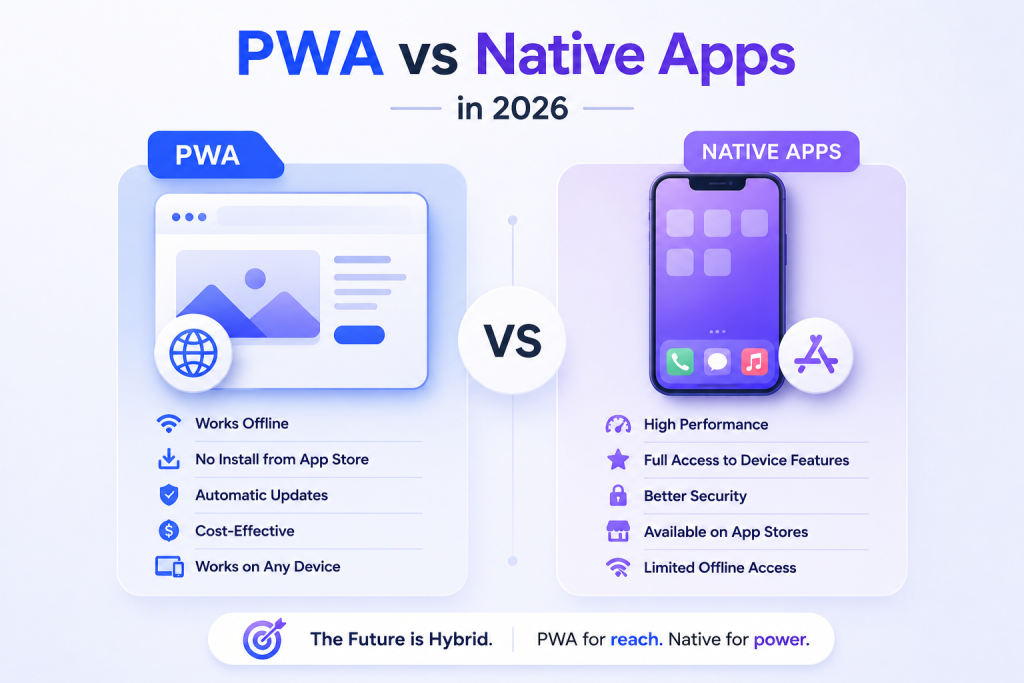
16 min readProgressive Web Apps vs Native Apps: The Complete 2026 Business Decision Guide
Every business thinking about building a digital product faces the same fork in the road: do...
9th Jun, 2026
13 min readGenerative Engine Optimization: What It Is and Why Your Business Needs It in 2026
You’ve invested months into SEO. Your blog ranks on page one. Your backlinks are solid. Yet...
18th May, 2026
14 min readGoogle Ads vs Meta Ads: The 2026 Guide to Smarter Ad Spend for Your Business
Here is a number worth stopping on: businesses waste an estimated 25 cents of every dollar...