
 +91 7044535163



Generative Engine Optimization: What It Is and Why Your Business Needs It in 2026
9th Jun, 2026
13 min read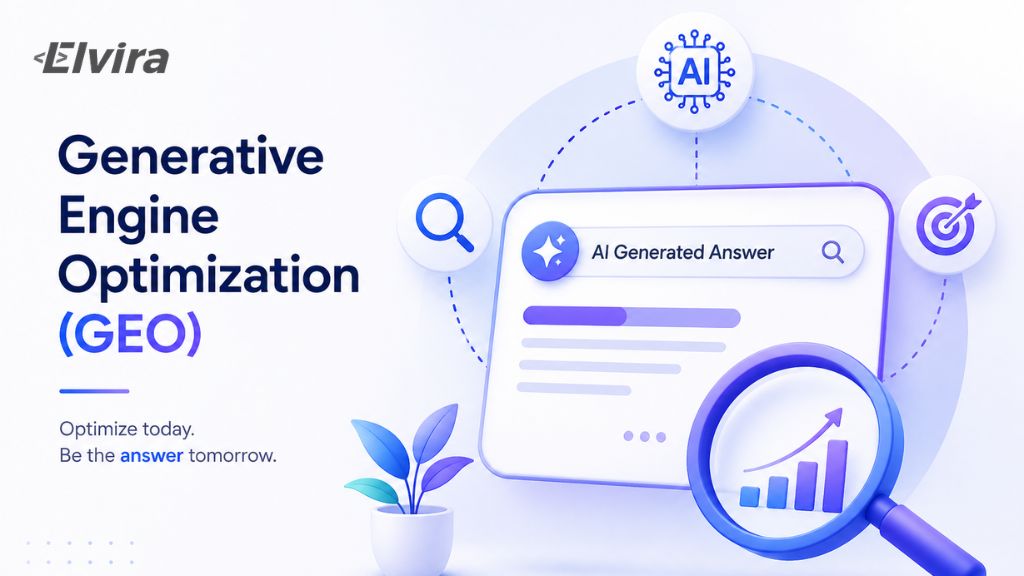
You’ve invested months into SEO. Your blog ranks on page one. Your backlinks are solid. Yet when a potential customer asks ChatGPT for the best solution in your category, a competitor gets named and you don’t. That’s not bad luck it’s a structural gap in your digital visibility strategy.
This is the reality that millions of businesses are waking up to in 2026. The way people search has fundamentally changed. AI assistants are now answering questions that used to send traffic to websites and the brands getting named in those answers are the ones doing something most businesses haven’t started yet.
It’s called Generative Engine Optimization, or GEO. This guide explains what it is, why it matters, how it differs from traditional SEO, and most importantly how to actually build a strategy around it.
What Is Generative Engine Optimization (GEO)?
Generative Engine Optimization is the practice of structuring your content and digital presence so that AI-powered platforms ChatGPT, Google Gemini, Perplexity, Claude, and Google AI Overviews cite, reference, or recommend your brand when users ask relevant questions.
Traditional SEO gets your pages to appear in a list of ranked links. GEO gets your brand named inside the AI-generated answer itself. That’s a fundamentally different goal, and it requires a fundamentally different approach to how you create, structure, and publish content.
The concept was first formally defined in a 2023 Princeton University research paper and has since grown into one of the most talked-about areas of digital marketing. The reason is simple: user behaviour has shifted faster than most marketing teams have adapted to it.
GEO is not about gaming AI. It’s about being genuinely useful, clearly structured, and authoritative enough that AI engines trust your content as a reliable source to cite..
800M+ ChatGPT weekly active users in 2026 | 60% of Google search results now show AI Overviews | 25% decline in traditional search volume projected by Gartner | 15.9% conversion rate from ChatGPT referral traffic |
How Generative AI Is Changing Customer Search Behaviour
For two decades, search meant typing a query, scanning a results page, and clicking a link. That model is being rapidly replaced. Today’s users are increasingly asking AI assistants conversational questions and receiving synthesised, direct answers without ever clicking through to a website.
ChatGPT now serves over 800 million weekly active users. Google’s Gemini has surpassed 750 million monthly active users, with a further 2 billion encountering AI responses through Google AI Overviews. Perplexity processed 780 million queries in a single month. These are not niche tools anymore they are the front door of the internet for a growing segment of users.
The behaviour shift is even more pronounced among younger audiences. Gen Z and younger users are bypassing traditional search bars entirely in favour of AI assistants. They don’t search for a list of options they ask for a recommendation and trust the answer they receive.
The critical implication for businesses: if your brand isn’t part of the answer the AI gives, you’re invisible to that user at the moment they’re most ready to act. And unlike a missed search ranking, there’s no position 2 or 3 in an AI response either your brand gets named or it doesn’t.
Gartner projects traditional search volume will decline 25% by 2026 and organic traffic could fall 50% by 2028. The window to adapt is now, not after the shift has already happened.
Why Traditional SEO Alone Isn’t Enough Anymore
Traditional SEO is far from dead we’ll come back to that. But it is no longer sufficient on its own. Here’s why.
When Google AI Overviews appear in a search result, the user often gets their answer directly on the results page without clicking any link. This is what’s known as a zero-click result, and the volume of them has been rising steadily. Ranking on page one no longer guarantees meaningful traffic if the AI is summarising your content before anyone reaches your site.
Meanwhile, AI assistants operate on a completely different logic to search engines. They don’t rank pages they retrieve and synthesise information from sources they assess as trustworthy, accurate, and well-structured. A site that ranks brilliantly for keywords may never get cited by AI if its content isn’t written and structured in a way that makes it easy for language models to understand and reference.
The businesses most at risk are those in high-research categories services, software, professional advice, e-commerce where users are using AI to shortlist options before they ever start clicking links. If your brand isn’t on that shortlist, the rest of your marketing funnel has a hole at the top that SEO alone cannot fill.
GEO vs SEO What’s Actually Different?
GEO and SEO are not competitors. They’re complementary disciplines that operate at different layers of the same visibility challenge. Understanding the distinction is the first step to building a strategy that covers both.
| Traditional SEO | Generative Engine Optimization (GEO) | |
| Goal | Rank in a list of links | Be cited inside an AI-generated answer |
| Target | Google Search results page | ChatGPT, Gemini, Perplexity, AI Overviews |
| Key signal | Keywords, backlinks, page authority | Content clarity, citations, structured data, expertise |
| User intent | Query-based (typed keywords) | Conversational (full questions and dialogue) |
| Content format | Keyword-rich long-form | Clear, direct answers with cited sources |
| Measurement | Rankings, clicks, impressions | AI citation frequency, brand mention rate, AI referral traffic |
| Traffic type | High volume, variable intent | Lower volume, very high intent converts at 15.9% |
| Foundation | Technical SEO + content | Strong SEO foundation + GEO layer on top |
Does GEO Replace SEO?
No and any guide that tells you otherwise is oversimplifying. Traditional organic search still sends 345 times more traffic than ChatGPT, Gemini, and Perplexity combined as of 2025. That ratio will narrow, but it won’t flip overnight.
The relationship is additive, not competitive. AI platforms largely pull from indexed web content which means crawlability, content quality, and domain authority signals from traditional SEO remain the foundation. Pages that rank poorly in Google tend to struggle in AI citations too, because the same underlying credibility signals matter to both.
What GEO adds is a second layer. It extends your SEO foundation into the AI-driven discovery layer by making your content more citable, more structured, and more clearly authoritative which improves performance in both traditional search and AI responses simultaneously.
AI search visitors account for just 0.5% of traffic but generate 12.1% of signups a 24-to-1 conversion ratio versus organic search (Ahrefs, 2025). The volume is small today. The quality is extraordinary.
Why GEO Matters for Your Business Right Now
The businesses being named in AI answers in 2026 are not necessarily the biggest ones. They’re the ones with the clearest, most trustworthy, most well-structured content. That’s a genuine equaliser for smaller teams and growing brands.
The conversion data makes the commercial case impossible to ignore. LLM-referred visitors convert at around 15.9% from ChatGPT, 10.5% from Perplexity, and 5% from Claude compared to a typical organic search conversion rate of just 1.76%. A user who arrives from an AI answer has already done their research inside the chat. They’re arriving with intent, context, and a shortlist your brand is already on.
AI Overview citations on Google also increase adjacent organic click-through rates by 35%, according to BrightEdge. Being cited by AI doesn’t just capture AI traffic it amplifies your traditional search performance at the same time.
For businesses in competitive categories, getting into the AI citation layer early creates a compounding advantage. The more your brand gets cited, the more it gets trained into the underlying models as an authoritative source. The earlier you start, the wider that moat becomes.
How Startups and Small Teams Are Using GEO to Compete
One of the most interesting dynamics of GEO is how it levels the playing field. Large brands have deep pockets for paid search and years of SEO authority built up. But AI engines don’t inherently favour big brands they favour accurate, well-structured, clearly cited content.
A startup that publishes a genuinely comprehensive answer to a specific question with clear expertise signals, proper citations, structured data, and a clean FAQ schema can get cited by ChatGPT over a Fortune 500 company whose content is vague, marketing-heavy, and hard for AI to parse.
Startups are exploiting this by identifying the specific questions their target buyers are asking AI assistants right now, and then publishing the best possible answer to each of those questions. They’re not trying to rank for every keyword they’re targeting the exact conversational queries that match their Category Entry Points and becoming the go-to cited source for each one.
This is a strategy that requires content quality and structure, not budget. Which means it’s accessible to teams of any size.
Optimizing Content to Be Cited by AI Search Engines
AI engines don’t read your content the way a human does. They parse structure, assess credibility signals, match content to query patterns, and decide whether your source is trustworthy enough to cite. Here’s what actually moves the needle.
Write for questions, not just keywords
AI assistants respond to conversational queries. Your content needs to mirror that format not just target a keyword phrase, but directly and clearly answer the full question a user might ask. The most citable content on AI platforms reads like a confident, well-sourced expert answering a question directly.
Use statistics and citations liberally
Research published alongside the original GEO concept found that adding quotations increased AI citation rates by 41%, statistics by 32%, and external citations by 30%. AI engines are trained to prefer content that demonstrates verifiable authority. Vague claims get skipped; sourced data gets cited.
Structure everything with schema markup
FAQ schema in JSON-LD format is the single highest-impact structured data type for GEO. It makes your question-and-answer pairs directly machine-readable by language models. Every FAQ section on your website should be marked up properly. The AI isn’t just reading your text it’s looking for structured signals that tell it exactly what question you’re answering and what your answer is.
Establish genuine E-E-A-T signals
Experience, Expertise, Authoritativeness, and Trustworthiness Google’s E-E-A-T framework apply equally to GEO. AI engines assess whether your content comes from a credible source on the topic. Author credentials, clear business identity, external mentions in trusted publications, and consistent content quality across your site all contribute to the credibility signals that make content more citable.
Building a Generative Engine Optimization Strategy Step by Step
A GEO strategy isn’t a separate campaign that runs alongside your SEO. It’s a layer you build on top of your existing content and SEO foundation. Here’s how to approach it in a way that works for teams of any size.
| 01 | Audit Your Current AI VisibilityBefore building anything, find out where you stand today. Ask ChatGPT, Perplexity, and Gemini the questions your ideal customers would ask in your category. How often does your brand get mentioned? What brands are being named instead? This baseline shapes everything that follows. |
| 02 | Map Your Category Entry PointsCategory Entry Points (CEPs) are the specific questions and moments when a buyer asks ‘What’s the best solution for X?’ Map out the 10 to 20 most important questions people in your target audience are asking AI assistants right now. These become your GEO content targets. |
| 03 | Create or Upgrade Content Around Each CEPFor each question, create the most direct, well-sourced, clearly structured answer possible. Use your own expertise and data. Cite external sources. Write as if you’re the most helpful expert on the topic because that’s exactly what AI engines are looking for. |
| 04 | Implement Structured Data Across All Key PagesAdd FAQ schema to every page with a question-and-answer section. Apply Article schema to your blog posts. Use HowTo schema for process-based content. This isn’t optional for GEO structured data is how AI engines reliably extract and classify your content. |
| 05 | Build Brand Mentions in Trusted External SourcesAI engines pull from places they trust: official brand pages, Wikipedia, credible industry publications, expert reviews, community forums. Get your brand mentioned and cited in these contexts. A structured PR and digital authority strategy directly feeds GEO performance. |
| 06 | Track AI Citation Metrics MonthlyStandard SEO metrics don’t capture GEO performance. Set up monitoring for AI citation frequency across ChatGPT, Perplexity, and Gemini for your target queries. Track AI referral traffic in GA4. Monitor brand mention rate in AI-generated responses. These are your GEO KPIs. |
| 07 | Refresh Content Regularly Recency MattersAI models are increasingly weighted toward recent content. A well-researched article from 2023 will lose ground to an updated equivalent from 2026. Build a content calendar that includes regular updates to your most important GEO-targeted pages with new data, new examples, and current dates. |
Designing Landing Pages That Work for AI-Driven Discovery
Traditional landing pages were built to convert traffic from search results with bold headlines, conversion-focused CTAs, and persuasive copy. GEO landing pages need to do something different first: they need to be credible, informative, and clearly structured enough for AI to use as a source.
This doesn’t mean removing your conversion elements. It means adding an additional layer underneath them. Clear, factual content about what you do and who you help. Specific and verifiable claims. An FAQ section with schema markup. External validation through credentials, certifications, and mentions. A clearly identified team or author with demonstrable expertise in the topic.
Pages built this way perform better in both traditional search and AI citation, because the signals that make content citable to AI clarity, structure, credibility are the same signals that improve SEO performance and user trust simultaneously
Best Practices That Separate Cited Brands from Invisible Ones
The difference between brands that consistently appear in AI answers and those that don’t usually comes down to a small number of disciplined practices.
Answer the full question in your first paragraph. AI engines parse the opening of your content first. If your article spends three paragraphs building up to the answer, the AI may not find it. State your clearest answer at the top, then support it below.
Use original data wherever possible. Content that contains proprietary research, original survey data, or first-hand case studies is cited at significantly higher rates than content that only summarises what others have already said. If you have data, use it prominently.
Build topical authority rather than chasing individual topics. AI engines assess your site’s overall credibility on a subject area, not just the quality of one article. Publishing a cluster of deeply useful, interlinked content around a single theme builds the topical authority that makes every page in that cluster more citable.
Keep your technical foundation clean. Fast load times, mobile optimisation, clean crawlable code, and a well-structured sitemap still matter for GEO because most AI platforms still rely on web crawling as part of their content retrieval process. Poor technical SEO will limit GEO performance.
Content that includes statistics increases AI citation probability by 32%. Content with external citations improves it by 30%. Every claim you can support with a source makes your content more likely to be referenced in an AI answer. (Princeton GEO Research, 2023)
Want to Make Your Business Visible in AI Search Results?
GEO is still early enough that most businesses in most categories haven’t done it properly yet. The brands that move now build a citation advantage that compounds over time and becomes increasingly difficult for later movers to close.
Elvira Infotech is an ISO 9001 certified digital marketing and development company. We help businesses build GEO and SEO strategies that ensure their brand gets found whether a potential customer is typing into Google, asking ChatGPT, or consulting Perplexity. From content strategy and structured data implementation through to technical SEO and ongoing AI citation monitoring, we cover the full picture.
Reach out to the Elvira Infotech team. We’ll audit your current AI visibility, identify the highest-value citation opportunities in your category, and build a strategy that puts your brand in the answer.
Our Recent Blogs
13th Jul, 2026
16 min readProgressive Web Apps vs Native Apps: The Complete 2026 Business Decision Guide
Every business thinking about building a digital product faces the same fork in the road: do...
18th May, 2026
14 min readGoogle Ads vs Meta Ads: The 2026 Guide to Smarter Ad Spend for Your Business
Here is a number worth stopping on: businesses waste an estimated 25 cents of every dollar...

6th May, 2026
13 min readWeb Design Services: What They Include and Why They Matter for Your Business
Your website is working right now or it isn’t. It’s either turning visitors into customers, building...