
 +91 7044535163



Agentic AI for Business: A Plain-English Guide to What It Does and Where It Pays Off
23rd Oct, 2026
12 min read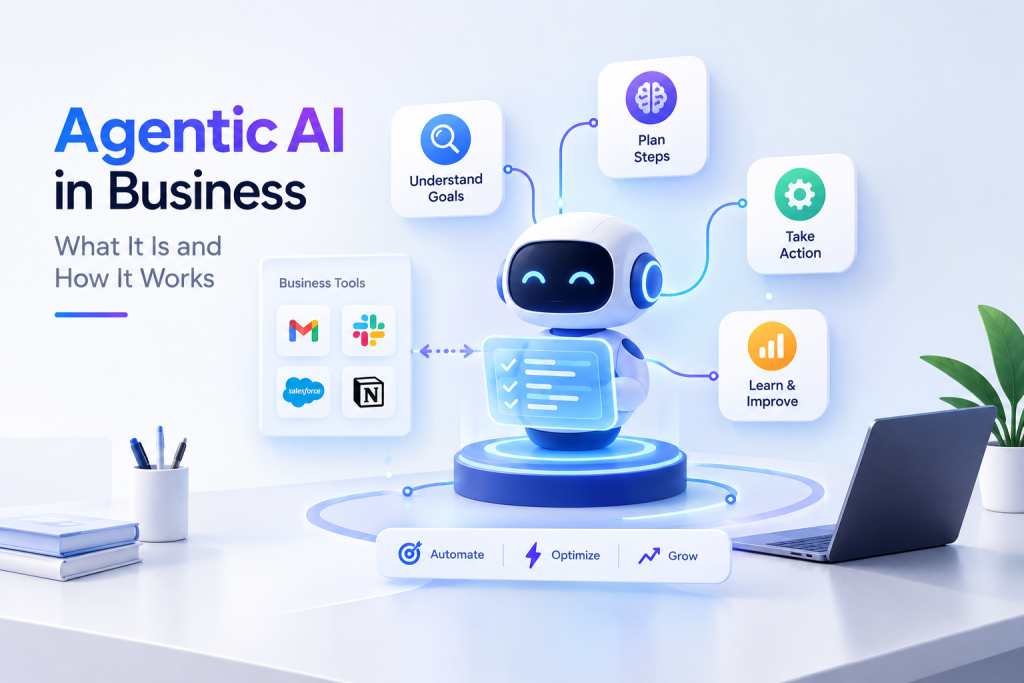
Most of us have used an AI tool that answers questions or writes a draft. You type, it replies, and then it waits for you to type again. That’s useful, but it still leaves you doing the work of moving things forward.
Agentic AI changes that. Instead of waiting for the next prompt, it takes a goal, figures out the steps, and gets on with it. For any business trying to cut busywork and move faster, that’s a big shift, and it’s why agentic AI for business is one of the most talked-about topics right now.
Let’s walk through what it is, how it works, where it helps, and what to check before you jump in.
What Is Agentic AI?
Agentic AI refers to AI systems that can pursue a goal with a fair amount of independence. You tell the system what outcome you want. It then plans the steps, uses the tools it has access to, makes decisions along the way, and adjusts if something doesn’t go as expected.
Think of the difference between a calculator and an assistant. A calculator does exactly what you press. An assistant hears “get this report to the client by Friday” and handles the pulling, checking, formatting, and sending.
The word “agentic” comes from “agency,” meaning the ability to act. These systems don’t just produce an answer. They take action.
How Does Agentic AI Work?
Under the hood, most agentic systems follow a loop that looks a lot like how a person tackles a task.
It starts by understanding the goal
The agent takes in a goal, plus whatever context it can reach: your documents, databases, emails, or live data from other software. A large language model usually sits at the center, acting as the “brain” that reads and reasons.
Then it plans and acts
The agent breaks the goal into smaller steps and decides which tools to use for each one. That might mean searching a database, calling another application, sending a message, or updating a record. This is where connections to your existing software matter most, and we’ll come back to that shortly.
Finally, it checks and learns
After acting, the agent looks at the result. Did it work? If not, it tries another route. Over time, feedback helps it get better at similar tasks. Many setups also include checkpoints where a person reviews or approves important actions before they go through.
Agentic AI vs Generative AI vs Traditional Automation
These three get mixed up a lot, so here’s a simple way to tell them apart.
| Traditional automation | Generative AI | Agentic AI | |
| What it does | Follows fixed rules | Creates content when prompted | Pursues a goal across multiple steps |
| Handles surprises | Poorly, it breaks | Only inside the chat | Adapts and re-plans |
| Needs a human prompt | For setup only | For every output | For the goal, then mostly independent |
| Typical example | “If invoice arrives, file it” | “Write a summary of this invoice” | “Review all invoices, flag mismatches, and ask suppliers to fix them” |
Generative AI is often a part of an agentic system, since the agent uses it to read, write, and reason. But on its own, generative AI produces; agentic AI produces and acts. And unlike traditional automation, an agent doesn’t need every scenario scripted in advance.
Types of Agentic AI Systems
Not every agentic setup looks the same. A few common patterns show up in practice.
A single-agent system is one agent handling a defined job, such as answering routine support requests or triaging incoming leads. It’s the simplest place to start.
A multi-agent system uses several agents, each with a specialty, that pass work between them. One might gather data, another analyzes it, and a third drafts the output. This mirrors how a small team works.
Some systems are reactive, responding to events as they happen, like an agent that springs into action when a payment fails. Others are proactive, watching for patterns and stepping in before a problem grows.
Finally, there’s a split between fully autonomous agents and human-in-the-loop designs, where a person approves key steps. For most businesses, the second option is the safer starting point.
The Advantages of Agentic AI
The appeal is easy to see once you picture the daily grind inside a company.
Agents can take over repetitive, multi-step work that eats up hours, which frees your team for tasks that need judgment and creativity. They run around the clock, so a request that arrives at midnight doesn’t sit until morning.
They also handle variety better than old-style automation. When a customer asks something slightly unusual, an agent can reason through it instead of failing on an unexpected input.
And because they work across systems, they cut down the copy-pasting between tools that slows teams down. Fewer handoffs usually mean fewer mistakes and quicker turnaround.
Examples of Agentic AI
Here are a few real-world style examples to make this concrete.
A customer support agent reads an incoming complaint, checks the order history, issues a refund within set limits, and replies to the customer, escalating to a person only when the case is unusual.
A sales agent monitors new leads, researches each company, drafts a tailored first message, and books a meeting on the calendar when someone replies.
An IT agent spots an unusual login, checks it against known patterns, locks the account if needed, and opens a ticket with the details already filled in.
A supply agent notices stock running low, compares supplier prices and delivery times, and prepares a purchase order for a manager to approve.
What Agentic AI Means for Enterprise Teams
For larger organizations, the story is less about one clever tool and more about how work gets organized.
Teams spend a surprising amount of time on coordination: chasing approvals, updating systems, pulling reports. Agents can absorb much of that. Employees shift from doing every step to setting goals, reviewing results, and handling exceptions.
That changes roles too. People who once spent hours on data entry may become the ones supervising agents and improving how they work. It’s less “robots replace staff” and more “staff get a capable assistant for the dull parts.”
It also raises the stakes on data quality. Agents are only as good as the information and systems they can reach, so tidy, well-connected data becomes a real advantage.
Where Agentic AI Delivers Measurable Business Impact
The numbers show why leaders are paying attention, and also why they should stay realistic.
Research firm Gartner expects around 40% of enterprise applications to include task-specific AI agents by the end of 2026, up from less than 5% the year before. It also projects that by 2029, agentic AI could resolve 80% of common customer service issues without human help, bringing operating costs down by about 30%.
| Trend | What the research says |
| Enterprise apps with built-in AI agents | Under 5% in 2025 to about 40% by end of 2026 |
| Common support issues resolved without a human | Around 80% by 2029 |
| Possible reduction in operating costs for those cases | About 30% |
| Agentic AI projects at risk of cancellation | Over 40% by 2027, mostly due to cost and unclear value |
That last row matters. Plenty of projects stall because the goal was fuzzy or the costs crept up. The businesses seeing results tend to start with a narrow, well-defined job and measure it from day one.
How Agentic AI Works in Different Industries
Marketing
Agents can monitor campaign performance, shift budget toward what’s working, and draft variations of ad copy to test. They can also segment audiences and personalize outreach based on behavior, then report back on what changed. Marketers still set the strategy and brand voice, while the agent handles the constant tweaking.
Financial services
In finance, agents help with fraud monitoring, document checks, and compliance reviews. An agent can flag an odd transaction, gather the relevant history, and prepare a case for an analyst to review. Because the stakes are high, human sign-off is usually built in for anything that affects money or customers.
Retail
Retailers use agents for inventory planning, dynamic pricing, and shopping assistance. An agent might notice a product trending, check stock levels, and suggest a reorder, while another helps shoppers find the right item through conversation instead of endless filters.
Travel and hospitality
Here, agents can handle itinerary changes when a flight is delayed, rebook connections, update hotel reservations, and notify the traveler, all in one flow. For hotels, agents can manage guest requests and adjust staffing or pricing based on demand.
The Challenges of Agentic AI Systems
It’s not all smooth sailing, so here’s what tends to trip businesses up.
Reliability is the first worry. Agents can misread a situation or act on wrong information, and one small error can ripple through several connected steps.
Integration is another. Agents need access to your tools, and older systems don’t always make that easy.
Cost can surprise people. Running capable models across many steps adds up, especially when a task loops more than expected.
Security and privacy come into play whenever an agent can read sensitive data or take actions on its own. And there’s a more human challenge too: teams need time to trust the system and learn to work with it.
Gartner has also pointed out that many vendors claim to offer agentic AI without really delivering it, a habit sometimes called “agentwashing.” It pays to ask for proof, not promises.
Governance, Trust, and the Human Oversight Question
The more freedom you give an agent, the more you need clear rules around it.
Good governance starts with deciding what the agent is allowed to do, what it can only suggest, and what always needs a person’s approval. A refund under a small amount might be automatic, while a large contract change might require a manager.
Keep a record of what the agent did and why. Logs make it possible to review decisions, fix mistakes, and meet audit requirements. Regular testing matters too, because agents can behave differently as data and conditions change.
Oversight shouldn’t feel like a brake on progress. It’s what lets you widen an agent’s responsibilities safely over time.
What Business Leaders Should Evaluate Before Deploying
Before committing, a handful of questions are worth asking.
Is the task clearly defined, with a result you can measure? Agents do best on focused jobs. Is your data accurate and accessible, or will the agent be working blind? Which systems does it need to connect to, and are those connections safe and well-documented?
Think about risk as well. What’s the worst thing that could happen if the agent gets it wrong, and is a person positioned to catch it? Finally, decide how you’ll judge success. Time saved, cost per task, error rates, and customer satisfaction are all practical measures.
Starting small, proving the value, and then expanding is almost always smarter than a big-bang rollout.
How Do I Integrate AI Agents Into My Existing Software?
This is where the practical work happens, and it brings us to something every business website and app already relies on: APIs.
An API is a standard way for two pieces of software to talk to each other. Agents use APIs to read from and write to your CRM, helpdesk, payment system, inventory tool, and more. The cleaner and better documented your APIs are, the easier it is for an agent to do real work.
A sensible approach looks like this. Pick one workflow. Map out which systems it touches. Connect the agent through secure, permission-limited access so it only reaches what it needs. Test it with a person reviewing every action, then loosen supervision gradually as confidence grows.
If your current software has no usable APIs, that’s worth fixing first. Strong API integration is the foundation that makes agents, and plenty of other automation, actually dependable.
Get in touch with Elvira Infotech. Tell us which process is eating your team’s time, and we’ll help you work out where agentic AI fits, what it should connect to, and how to roll it out safely.
Frequently Asked Questions
What is the difference between agentic AI and generative AI?
Generative AI creates content such as text, images, or code when you give it a prompt. Agentic AI uses that kind of intelligence to pursue a goal across several steps, using tools and making decisions along the way. In short, generative AI produces, while agentic AI produces and acts.
How do I measure the ROI of agentic AI?
Start with a baseline before launch: how long the task takes, what it costs, and how often errors occur. After deployment, compare those numbers against agent-handled work, and include running costs such as model usage and oversight time. Softer gains, like faster response times and happier customers, are worth tracking alongside the hard savings.
What happens when an agent gets stuck?
A well-designed agent knows its limits. When it hits something unclear, a failed step, or a request outside its permissions, it should pause and hand the task to a person with full context so nobody has to start over. Setting retry limits and escalation rules in advance prevents agents from looping endlessly.
How do I integrate AI agents into my existing software?
Begin with one workflow, identify the systems involved, and connect the agent through secure APIs with limited permissions. Keep a human reviewing early actions, test thoroughly, and expand gradually. Clean, well-documented APIs make the whole process much smoother.
Can we ensure agentic AI is transparent?
You can get close, though not perfect. Detailed activity logs, clear explanations of why an action was taken, defined approval points, and regular audits all make agent behavior easier to understand. Transparency is easiest when it’s designed in from the start rather than added later.
Final Thoughts
Agentic AI isn’t magic, and it isn’t just hype either. It’s a practical way to hand off multi-step work to software that can plan, act, and adapt, as long as you give it a clear job, good data, and sensible guardrails. Start small, measure honestly, and build from there.
If you’d like a hand turning this into a real plan, Elvira Infotech can help. As an ISO 9001 certified company, Elvira Infotech works with businesses to design, build, and integrate smart digital solutions, from API integrations to AI-powered workflows, shaped around each client’s goals rather than a one-size-fits-all package. Reach out to talk through where agentic AI could make the biggest difference for your business.
Our Recent Blogs
13th Jul, 2026
16 min readProgressive Web Apps vs Native Apps: The Complete 2026 Business Decision Guide
Every business thinking about building a digital product faces the same fork in the road: do...
9th Jun, 2026
13 min readGenerative Engine Optimization: What It Is and Why Your Business Needs It in 2026
You’ve invested months into SEO. Your blog ranks on page one. Your backlinks are solid. Yet...
18th May, 2026
14 min readGoogle Ads vs Meta Ads: The 2026 Guide to Smarter Ad Spend for Your Business
Here is a number worth stopping on: businesses waste an estimated 25 cents of every dollar...